
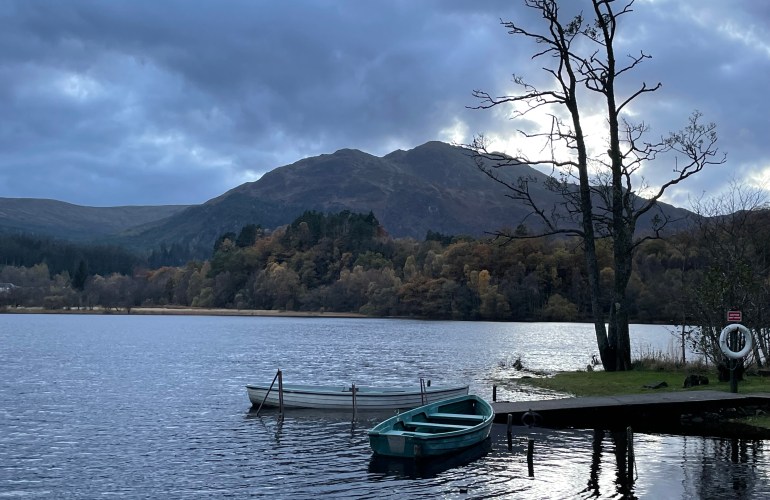

The journey from Birmingham to Crinan was all of 10 hours. The last two hours was in the dark and on narrow roads. It was a day of showers and windy downpours. There was the occasional bright sunshine. We had skirted past Glasgow, taking in such place names as Paisley, Renfrew, Greenock with Loch Lomond and the Trossachs to our east. Further up north we went towards Lochgilphead and finally Crinan where our hotel overlooked the Crinan canal and the sea.
Our hotel was an old-fashioned hotel, at a turn in the road, with a most magnificent view. Wherever you turned there was the sea and the hills. Our first evening, dinner was at the bar restaurant. An older couple were across from us. He had a trace of a South African accent. He had been shooting; I thought pheasants but he demurred, ‘deer’, he said. I said, ‘Oh, you’ve been killing them’. He replied, ‘No, culling them.’ They had been to the hotel several times in the past and loved the food. Everybody loved the food. A younger couple, probably our age, so not so young after all, sat at the bay window. The waiter was a slim and small woman with dark hair, somewhat like a matchstick stood on its wood end and the flammable shock of dark hair. She appeared young until you looked closely. She was agile, friendly and lively.
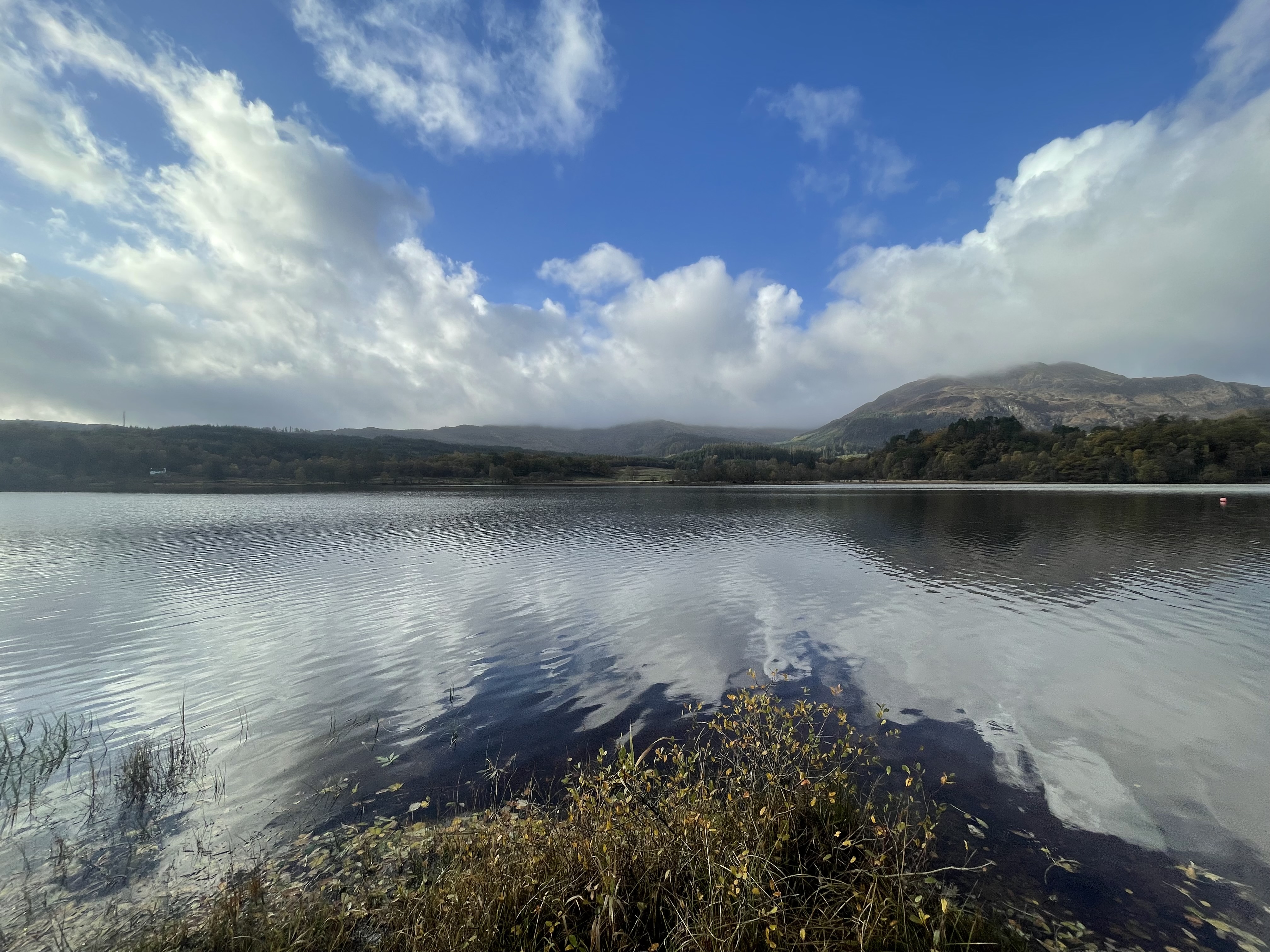
When we woke up and looked out through our window, there was the sea, fretted with the most subtle corduroy weave of indigo and in the horizon were hills, stretching from one end to the other in shades of grey through to black, separating the sea from the sky.
Breakfast was in the main dining room. There were tables right up close to the windows’ look out to the breath-taking views of Crinan canal and sea loch. It was full Scottish breakfast of eggs, bacon, haggis, black pudding, and potato cake. We were surprised, but perhaps we shouldn’t have been that this was yachting country with magnificent boats, bronzed and lean people, and a confidence that only owning a yacht brings. We stopped to watch one boat use the lock, French style, with the lock mistress working the lock. This was not like a canal for a barge or long boat. It was deep and the water rushed through with the momentum of waterfall. The yacht with its mast waited to move through the lock and it was all hands on deck, very practised and efficient moves from ropes to anchor, and then it glided past us through to the loch and on and away.
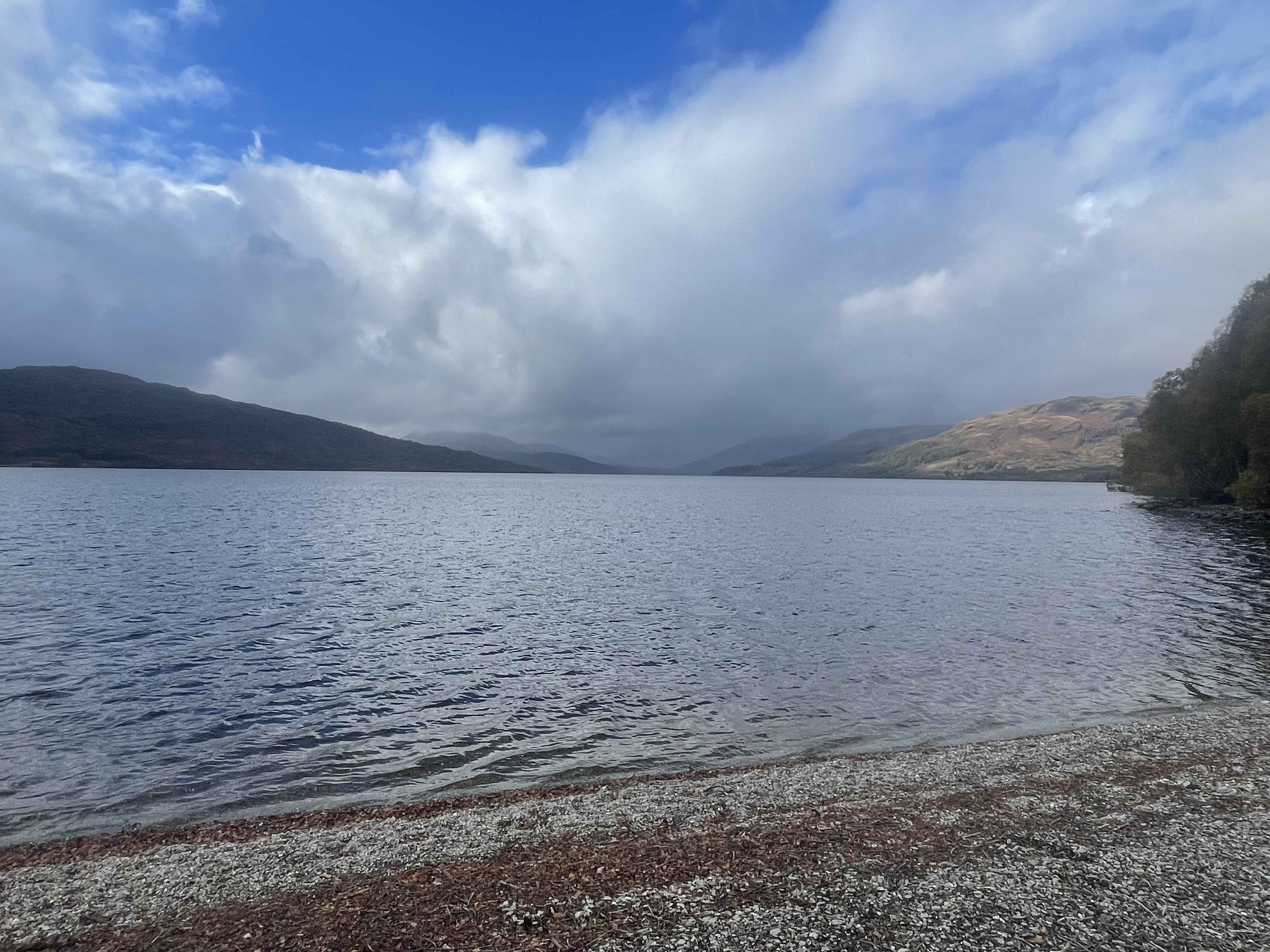
Then we had our walk along the canal. It was not much of a walk as the towpath was closed for safety reasons. But Lochgilphead reflected the sky, and the hills that framed it themselves were helmed by burnt ground cover that looked from the distance like sand. It is impossible to describe how a hill would be perfectly mirrored in the perfectly still loch. The canal too, mirrored the hedges of bracken, as it curved and straightened through the countryside.
It was two nights at Crinan before we drove across to Loch Melfort Hotel. On our way we stopped at Bellanoch, to be exact Knapsdale, to see from a vantage point what low clouds look like as they floated in between the loch and the blue sky. The clouds were like tufts of white wool just hanging there like an improbable vision. Then it was Kilmartin where we were transported back millennia to stone crops, standing stones, and burial mounds.
At Loch Melfort, our room opened unto a veranda that looked out to Loch Melfort. First, Highland cattle grazed 50 yards from us and beyond, the loch. The sunset to the west was glorious, painting the sky purple, violet, red and orange. The clouds were like wisps of angel hair, and where they were tinged by the evening light, had the lustrous look of russet blond hair streaking past in the distance. The loch too changed colour from an infinite blue through grey, silver, mercury, to slate black and then merging with the night and becoming indistinct.
Oban was the closest town to Loch Melfort. So, we headed out to Oban. I suppose you could say that McCaig’s Tower was a folly. Set up on a hill that we puffed our way up to. It was made of fake battlements with arch windows looking out to Oban Bay. The sky showed a different side to us. It was dark and rueful somewhat like the dark stonewalls of the Tower. Then it was Dunollie castle. From here you could look out to sea and see Maiden Island and beyond. The island sent out a tongue of land already brown and burnt and in the far distance other hills that stood resolute and bluish black, holding up clouds that seemed wary and afraid of falling into the sea.
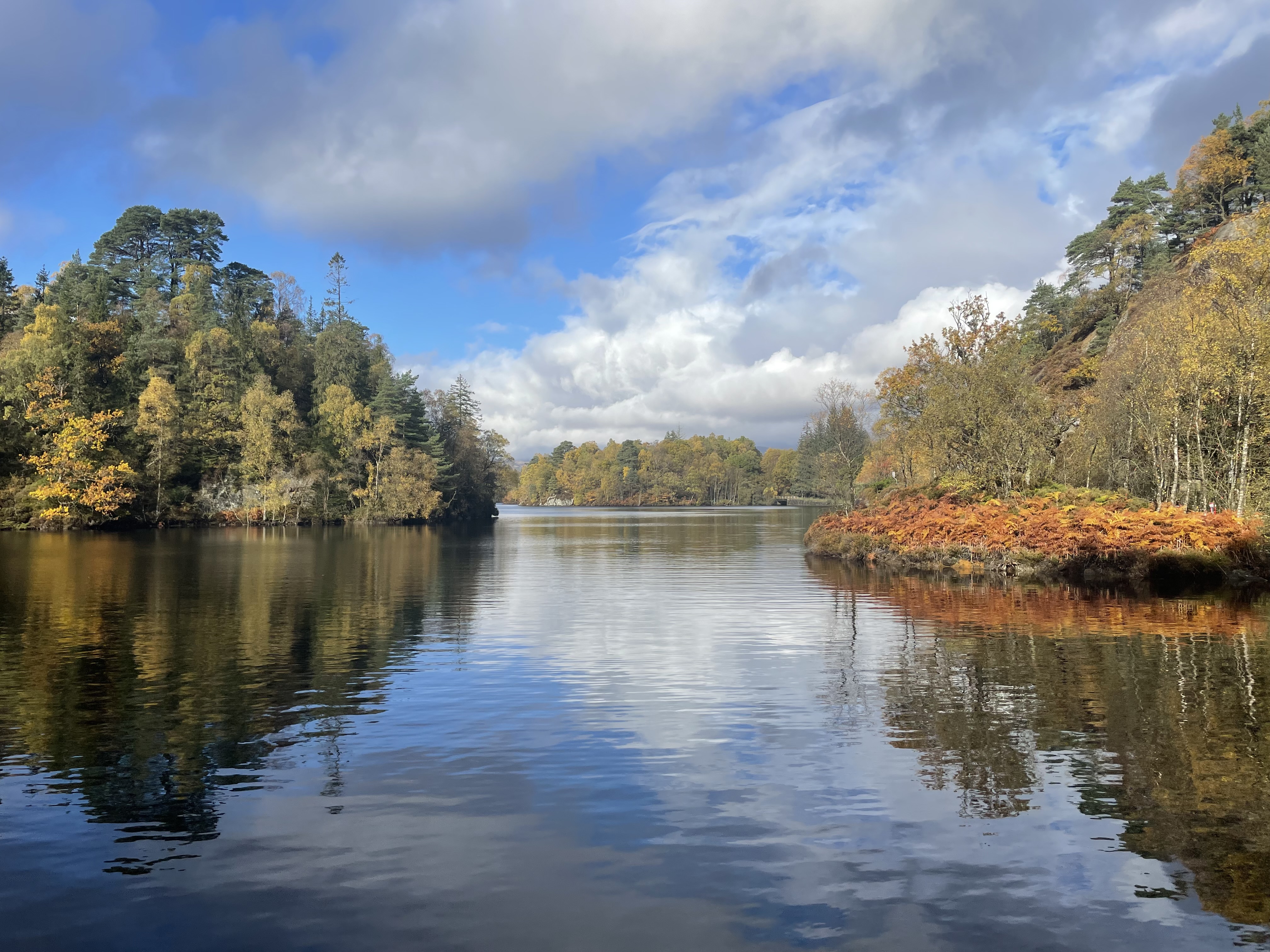
It is quite something to be travelling through the west of Scotland at this time of the year. It is all about the colours. This is when I wished I was a painter, that I could capture the glory of autumn, the remarkable tincture of reds and yellows, gold and rust, the transformation of chlorophyll, from green and olive to the plenitude of amber. Dunstaffnage castle overlooked Loch Melfort from a different aspect. Here were the woods, of pine, mountain ash, oak, silver birch, alder sweeping upwards away from the loch’s edge. A full-throated exhilaration of colour.
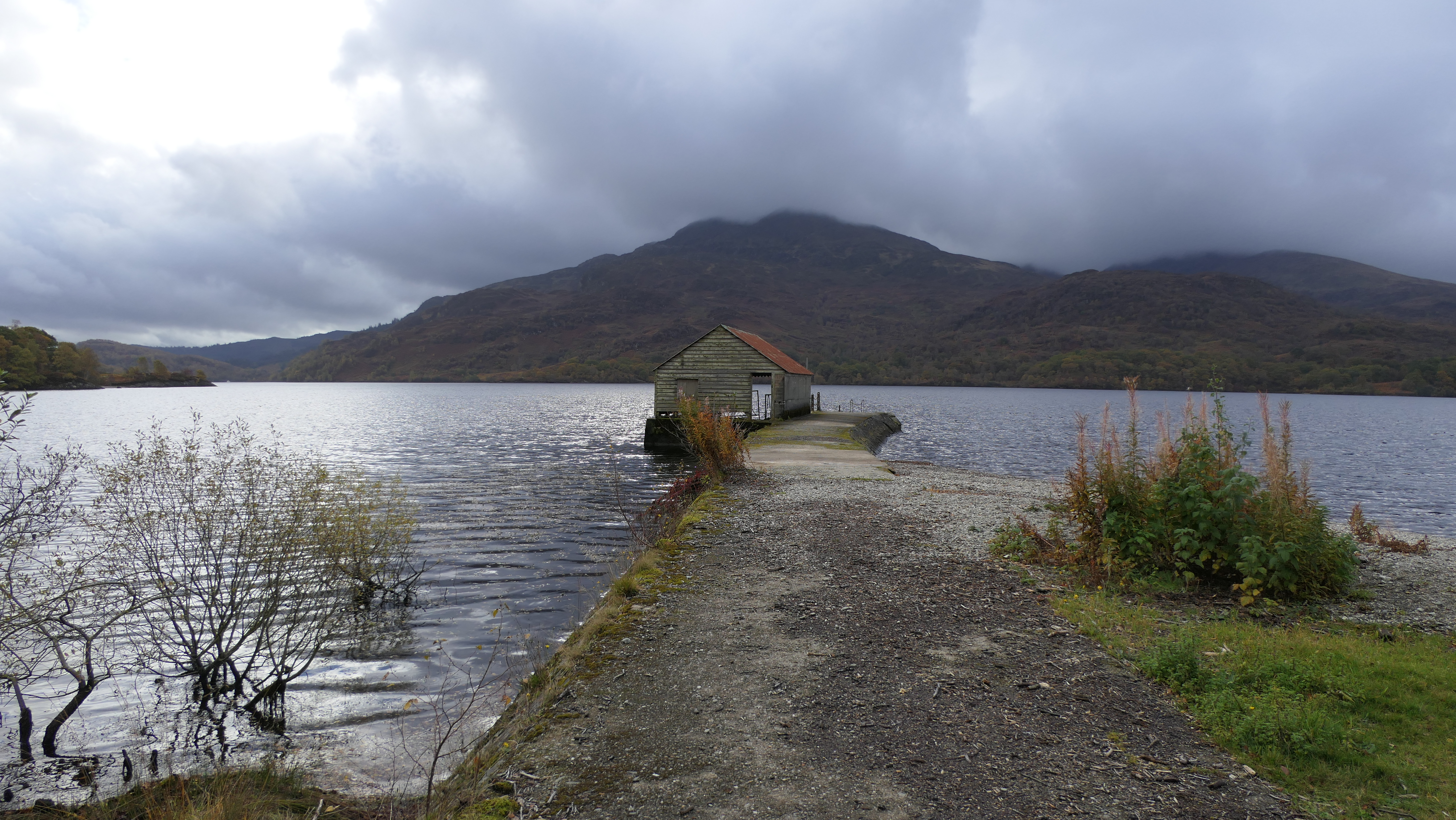
We have been aiming all of four days for the Trossachs and we had finally arrived just beyond Callander to our modern turreted castle, Tigh Mor, overlooking Loch Acray. We walked along Loch Katrine to a disused jetty with a picturesque cabin where Robert Louis Stevenson is said to have been inspired to write the Lady of the Lake and Franz Schubert to compose the Ave Maria. It is, indeed, a wonderful site. The loch’s water ripples past the jetty’s promontory, and the hills on the opposite side are imposing. On our day out, the clouds dark and bluish except for where the sun was peeping out like a shy child whose smile, once seen was iridescent.
Bracklinn Falls and Crags were a different proposition. We drove to Callander and parked the car. J as ever was quick on her feet, marching up the hill whilst I puffed and struggled my way behind her. Up at the falls, we met a young couple out for the day who wanted to talk about Birmingham and so on. Like me, he had a brolly, not trusting of the weather. His partner remarked on why ‘you men seem to need brollies’. The water tumbled down the fall and befitting its name, the water was speckled with a white foam. The return jaunt took us further uphill in the rain. Every time that I thought we couldn’t go any further upwards, the path wound upwards still. The countryside was spectacular with tufts of grass, ferns and bracken. Purple heather was in its glory. The hills, in the mist, seemed distracted and alien.
We spent a day travelling by train from Crianlarich to Fort William and back. The journey each way took almost 2 hours, an hour fifty-three minutes to be exact. Crianlarich station is unmanned. We had lunch at the Crianlarich hotel, just 10 minutes’ walk downhill from the station. After lunch we clambered back uphill to wait for the train that was reportedly running and on time. The train was due in at 14:24 but did not arrive and the station display board sopped referring to the train. It was neither cancelled or late, just disappeared. We waited until 14:30, then 14:35, and still, there was no show. We decided to call a day and leave and out of nowhere the trained arrived 20 minutes late with no apology nor explanation. We clambered in and we were off.
Our first stop was Upper Tyndrum, then Bridge of Orchy and then Rannoch. Loch Treag was to our west as we went downhill from Corrour and it stretched endlessly in mist, shrouded in mystery, a setting for a Gothic thriller novel, either with a disappearing lady and the culpable, all too culpable, laird. Flecks of white waves gave the impression that any time soon, we would arrive at a white sand beach and indeed we came past a beach that was grey and rocky. At Tulloch we were back to silver birch, mountain ash, larches and pine. The river was wild and quick to slip in between rocks, as it splattered downhill. We were now aiming for Roy Bridge, then Spean Bridge, and finally Fort William.
We got off at Fort William to an unwanted welcome of torrential downpour. There was nothing for it but to go out into the rain and walk the 250 yards of the main street to Station Square. I bought a waterproof cap at some outdoor shop and J bought a birthday present for C. We retraced our steps to the station to await our train back to Crianlarich.

Night was already falling, not that you could tell the difference as it was still raining. The sky was dark grey and the clouds hung over Ben Nevis as we approached Roy Bridge. Towards the station were white-painted dormer bungalows. Leaving Roy Bridge, we were quickly back in the wilderness of hills and trees with slender trunks, all leaning northwards.
We were now properly in nighttime. The darkness was like a cloak wrapped round our train as it raced towards Bridge of Orchy. Here there was no light pollution. The night was a thick and deep black ink stain. The train managed the traditional clack and run over the rails. There was not even a single point of light outside. Aside from the train’s information we had no idea where we were.
Suddenly, for the first time in close to 2 hours there was human settlement with more than a couple of lit up homes. This was Upper Tyndrum. The lights spread out quite a fair width of the valley, maybe 50 homesteads in the dense darkness. Then Crianlarich and our car.
We were now more or less at the end of our holiday. On the way home via Stirling we stopped first at Doune Castle, then Stirling Castle.

Photos by Jan Oyebode

 MindReadings
Beautifully written, felt as if I was there myself…
Thank you Fred. Femi
If you are ever in Scotland you are always welcome in North Berwick
Carol, thank you. I’ll keep that in mind. Trust you’re keeping well. Femi
We are fine, thanks
Thanks Femi and Jan for the portrait of Scotland…the best place in the world if the weather is right.
richard
Thank you Richard