


We were in Athens in the last week of January. The weather was an improvement on that at home; it was warm, dry and the sky an exquisite blue. At least most of the time, otherwise it was sultry and overcast.
Trump had just been inaugurated as President and the speed and sway of events were unmistakably terrifying. Here we were in Athens, staying not far from the Parthenon, which was above us on the Acropolis, and visible like a beacon which was what it was. This was after all the birthplace and home of democracy. But the collapse of democracy, in our time was already in play.
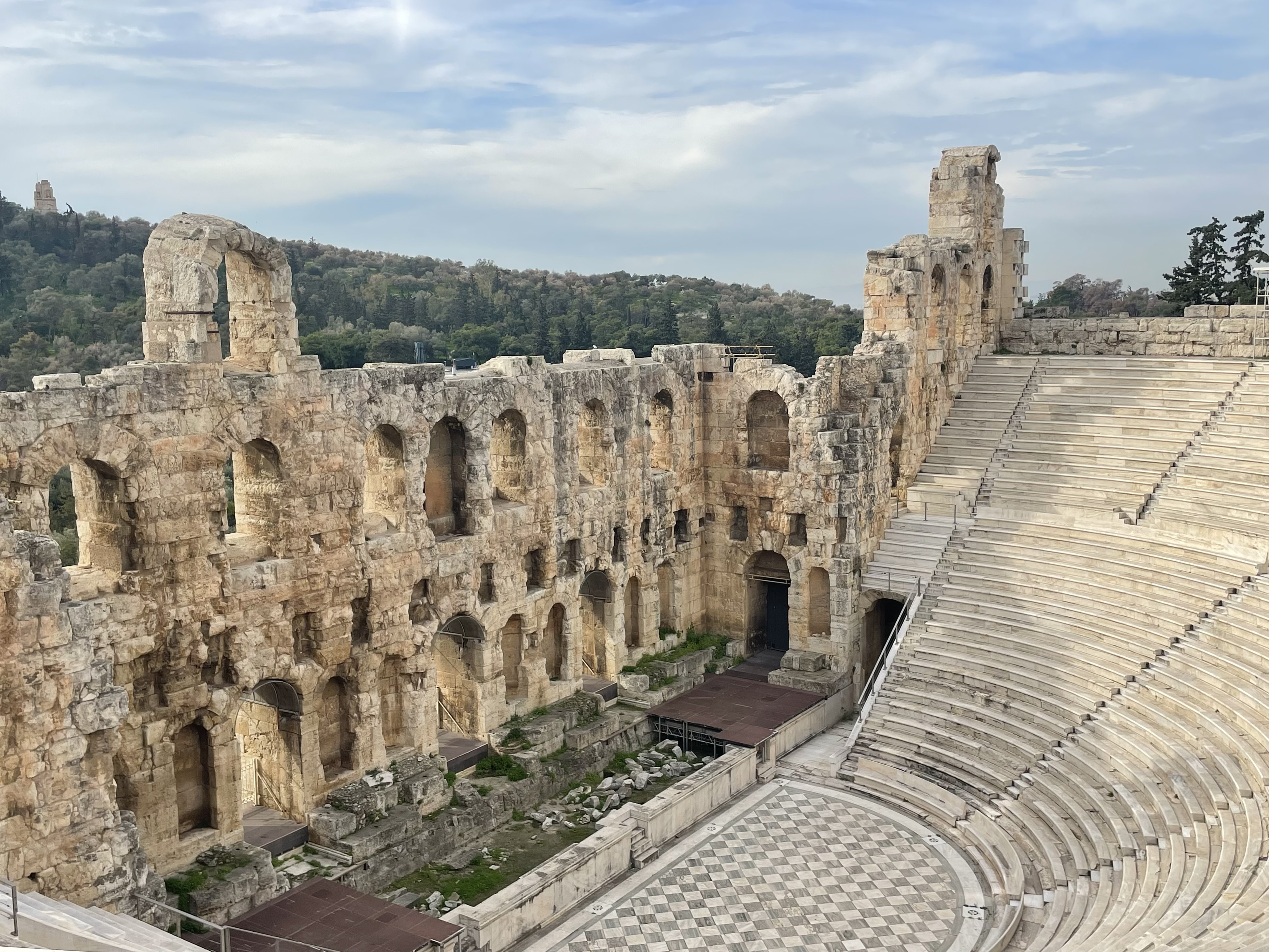
When we visited the Acropolis, our guide, Anastasia or Sisi for short, was a woman, perhaps in her early 50s with dark hair. She walked briskly, with that crisp energy that some short people have. We walked uphill and stopped, first, at the Theatre of Dionysius where the annual drama festival was held. Here, Aeschylus, Sophocles, and Euripides presented their tragedies, the Oresteia, Oedipus Rex, etc. I am working on a talk on Hecabe and the Women of Troy and imagined how they would have been received in their day by the audience.
We came to the Stoa of Eumenes, a colonnade along the south slope of the Acropolis connecting the Theatre to the Odeon of Herodes Atticus. This gallery was donated to Athens by Eumenes king of Pergamon. Here Zeno and his disciples discussed and formulated much of what has come down to us in the writings of the Roman Stoics.
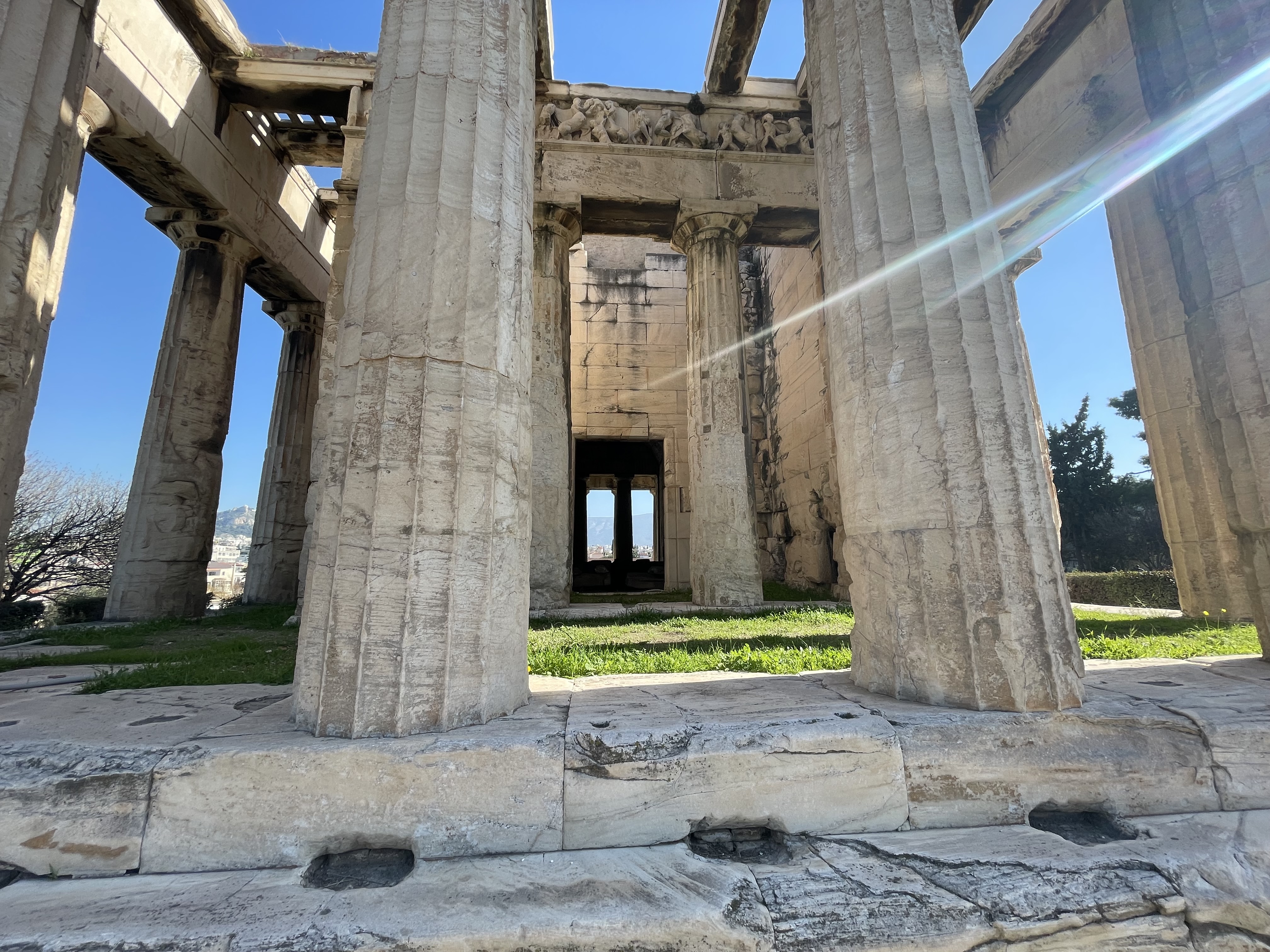
The Temple of Asklepios was next. Built as a sanctuary in honour of Asklepios and his daughter Hygeia. It is commonly thought of as the first hospital in Athens, with its pool and rooms. The relationship between poison and therapeutic drugs is wonderfully exemplified in the myth of the poisonous blood drawn from Gorgon used for treating diseases, hence pharmacy. The gardens and pool signalled non-medicinal treatments and hence the birth of the apothecary. Just beyond the Temple was the start of the Peripatos (the Philosopher’s Walk) where Aristotle’s School took their walks. We returned later at sunset to do this walk, skirting the Ancient Agora and Hadrian’s library. The sun was setting with a purplish, wine-red dye in the western sky.
The approach to the Acropolis was spectacular. The Ionic Temple of Athenae-Nike dominated the entrance. It was majestic as it stood to the right of us. It towered over the Propylaia entrance, itself magnificent and massive. It must have been impressive and unbelievable in its day with its ceiling and friezes, burnished and colourful as it opened into the Acropolis. The building of the Propylaia was overseen by Phideas himself and commissioned by Pericles, shortly before the Peloponnesian war. I loved the idea of Pan striking panic into the heart of the Persians, to assist Athens to defeat the Persians.
From up on the Acropolis, it was easier to see the Odeon of Herodes Atticus, king of Pergamon. It was an impressive, covered site that hosted musical performances and still does to this day, two thousand years on. Later, in the evening, we went to look through holes in the walls to see the arch of the amphitheatre, the true breadth of a site dedicated to the performance of music. There is an equally magnificent amphitheatre at Perga.
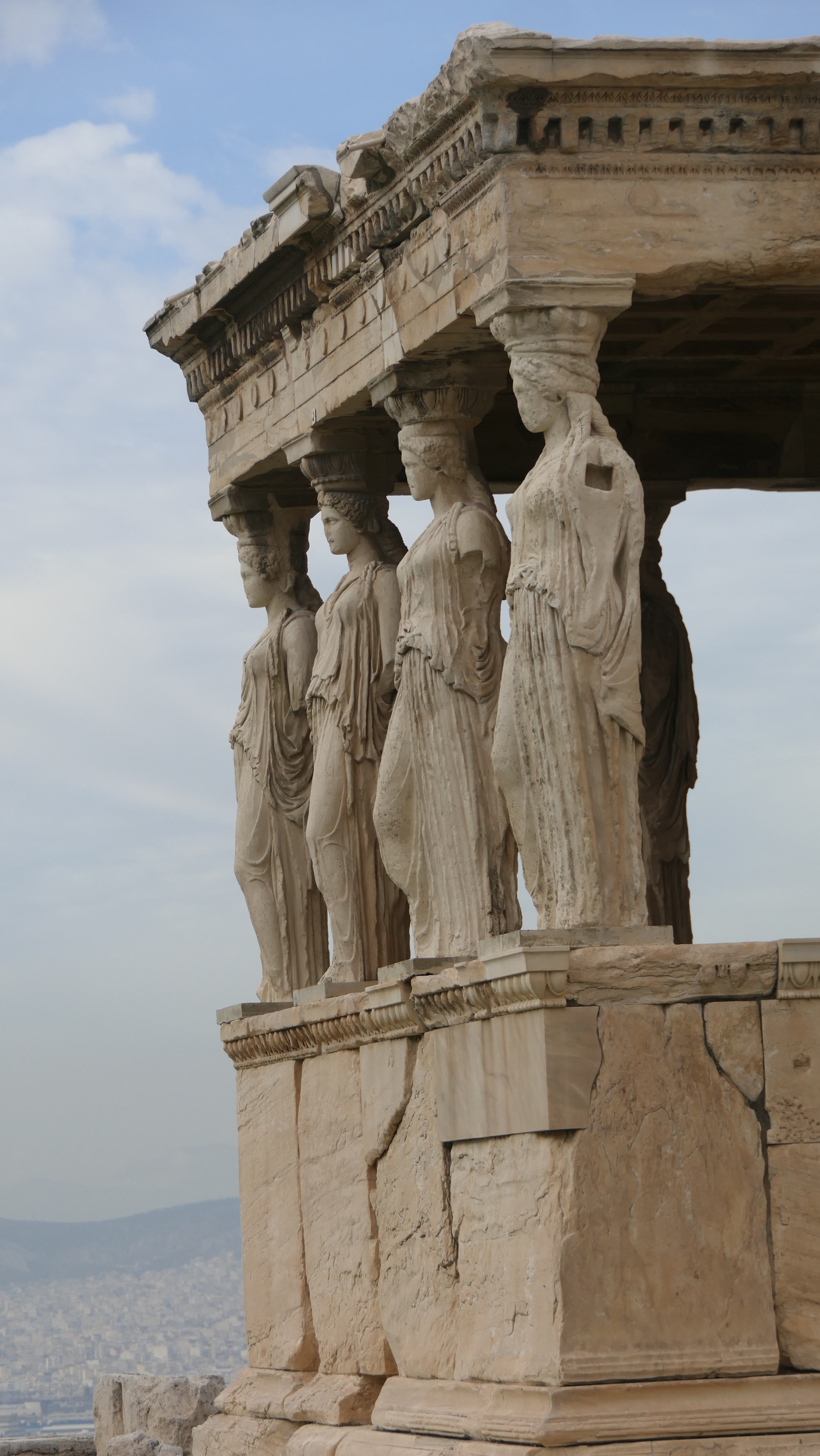
Within the Acropolis itself, the Erechtheion or Temple of Athena Polias, to the north of the Parthenon. It was built between 431 BCE- 406 BCE. It has a porch of the maidens (korai) or caryatids. Myth has it that the temple symbolised the race between Athena and Poseidon which Athena won. The Athenians also preferred her gift of an olive tree to Poseidon’s gift of salt and water. One of the caryatids was removed (stolen) and transferred to London by Lord Elgin. The plunder of other lands by imperial Britain has special significance for a person like me, who was born in a colony. The plunder of Benin art by British soldiers during what is shamefully called the Benin Punitive Expedition remains a touchy subject.

The Parthenon is impossible to describe without resorting to cliches. It has stood for over two thousand years, of course, requiring restoration because of its age. I suppose much like us men, we show the wear of the years and need rebuilding, sometimes re-fashioning, if not re-piping. And our lifespan is but 70 years or so. It celebrates the birth of Athena Pathenos, from the skull of Zeus, requiring no sexual intercourse. In the Christian period it was a Catholic Basilica, during the Ottoman period, it was a mosque where the Erechtheion was a harem. It was also a garrison during this period. It suffered considerable damage during the Byzantine period and then the depredation by Lord Elgin! Yet, it is still standing.
The construction of the Parthenon is itself a marvel- 17 pillars long and 8 pillars wide. The inner row of pillars number 6. The friezes, pediments and roofs are incredible. The adjustments to the width of the pillars in order to ensure that the view was pleasing was a master stroke of genius, combining as it did, mathematics, engineering, and aesthetics. The underlying principle was the Golden ratio of 1.618.
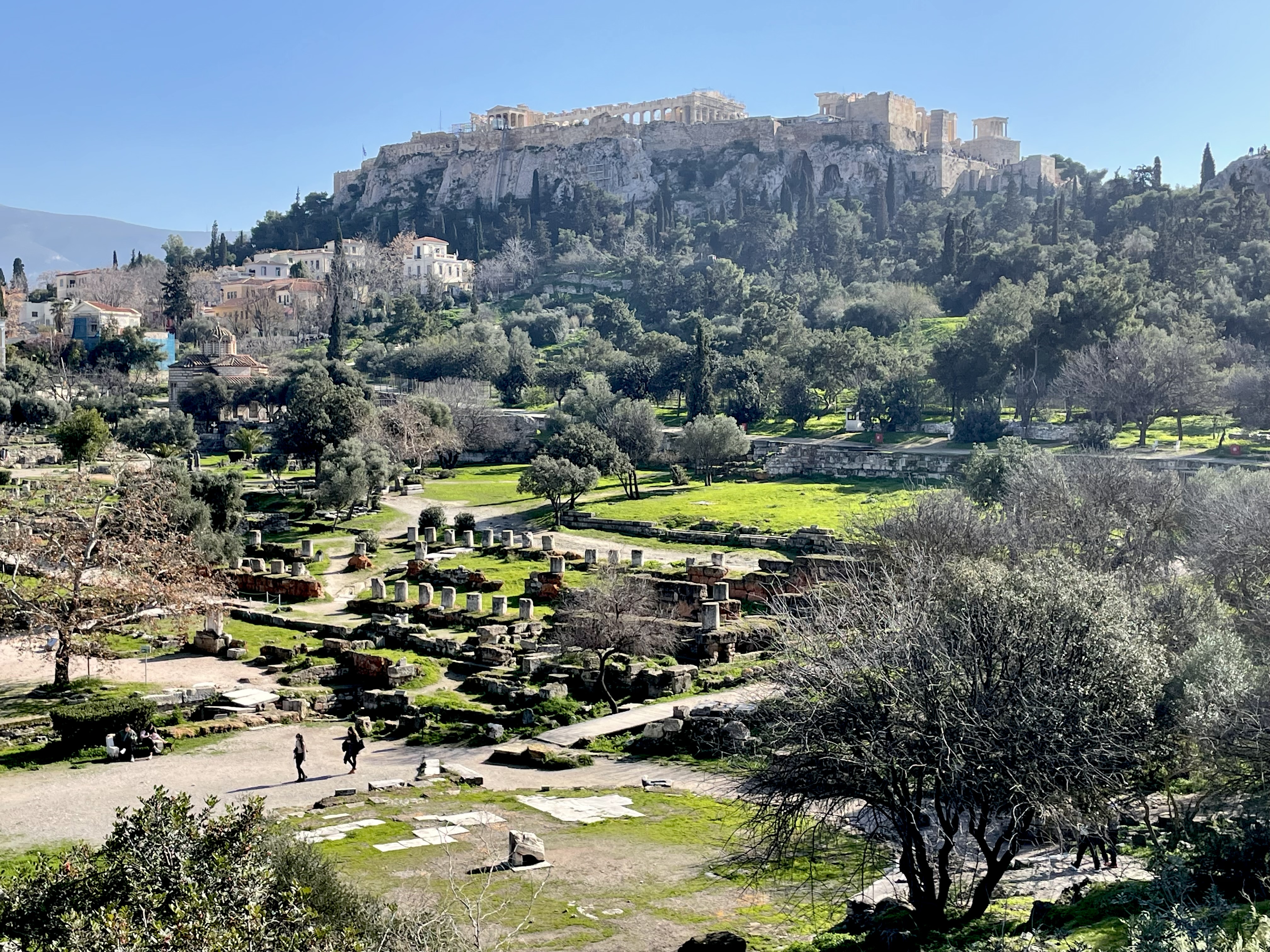
We later visited the Roman Agora, the Ancient Agora, the Temple of Hephaestus, the Temple of Olympian Zeus, the Stoa of Attalos, but it was at Kerameikos Cemetery that Pericles finally came alive for me. It was here that he delivered the funeral oration reported in Thucydides’ History of the Peloponnesian War. Referring to the system of government in Athens, he said
‘Let me say that our system of government does not copy the institutions of our neighbours. It is more a case of our being a model for others […] Our constitution is called a democracy because power is in the hands not of a minority but of the whole people. When it is a question of settling private disputes, everyone is equal before the law; when it is a question of putting one person before another in positions of public responsibility, what counts is not membership of a particular class, but the actual ability which the man possesses. No one, so long as he has it in him to be of service to the state, is kept in political obscurity because of poverty’.
If only this message was heard and understood in the country where democracy is most at risk to day.

Photos by Jan Oyebode

 MindReadings